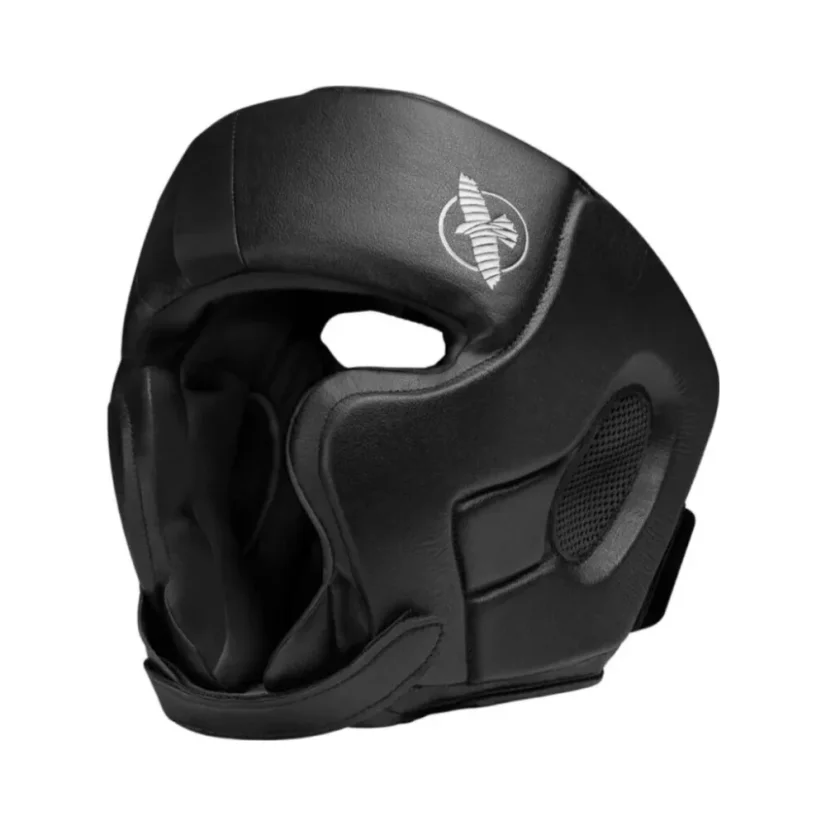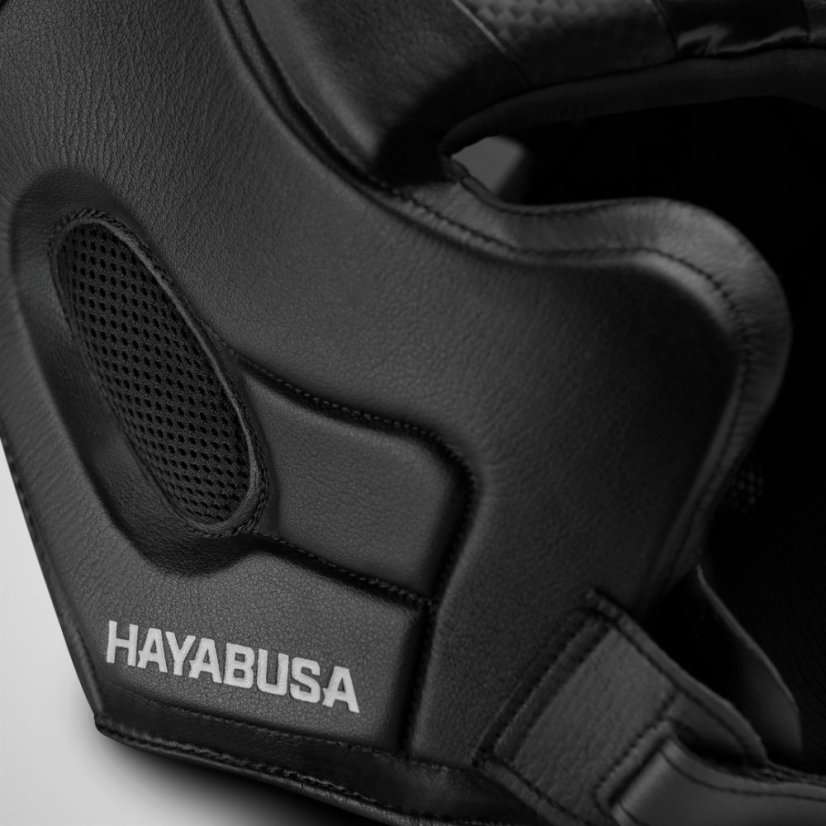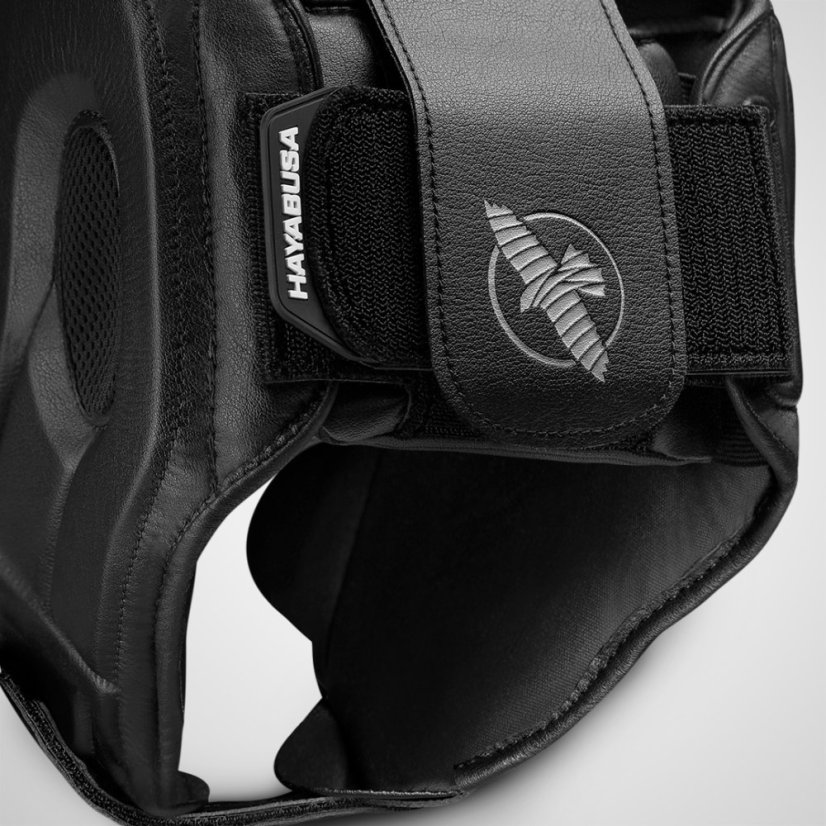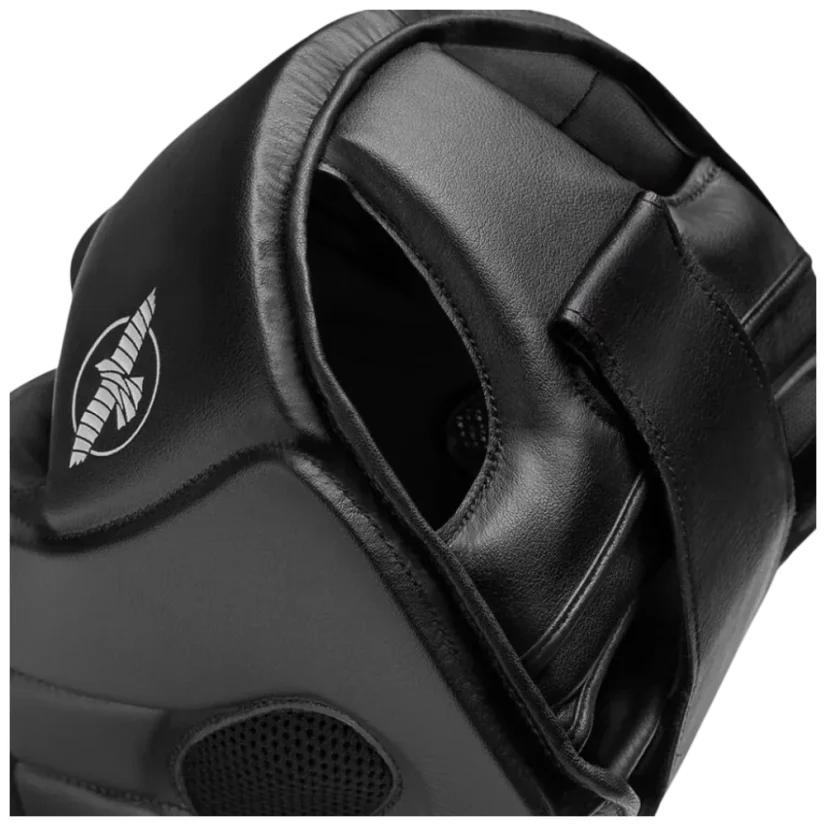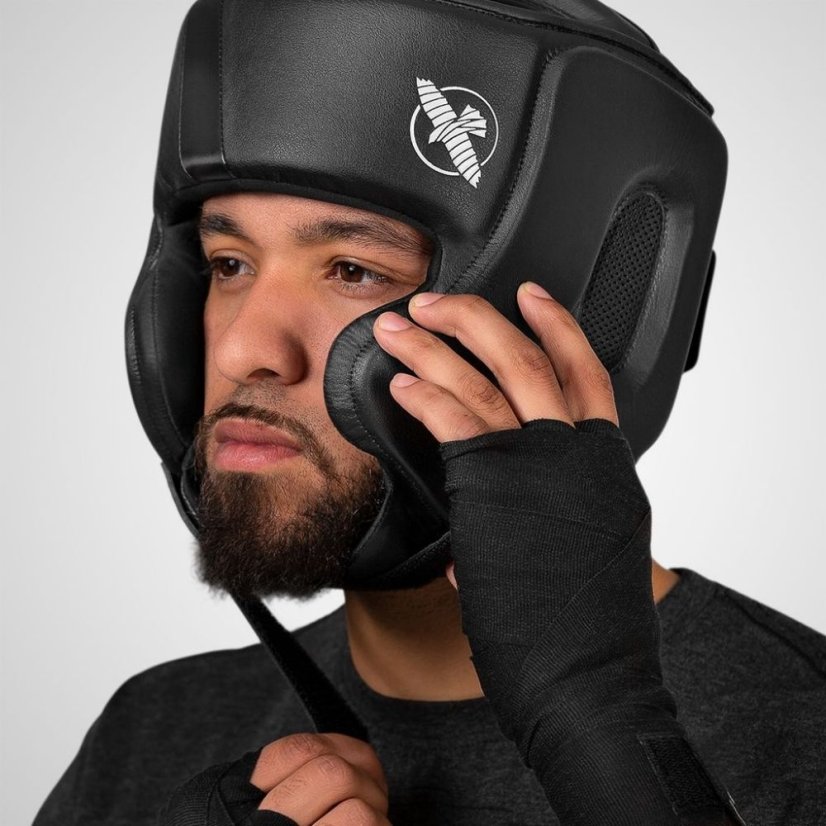

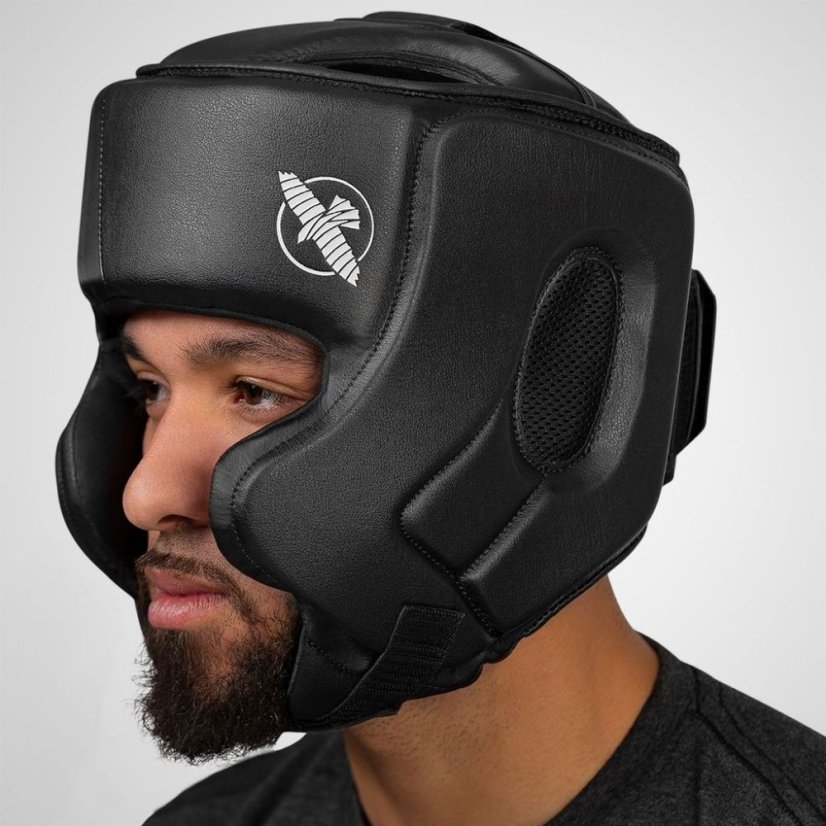
Hayabusa T3 Chinless Boxing Headgear – Black
Please select an option
Variant does not exist
L S/M
Original price 138,80 EUR. Save 10 % (13,80 EUR).
125 EUR
Hayabusa Key Features
– Premium soft cowhide leather
– EVA and PU foam padding
– Extra-wide field of vision
– Silky smooth nylon lining
– Cheek protection and covered ears
– Traditional lace-up and velcro closure
More info
Product code: P01031 Shipping and Payment

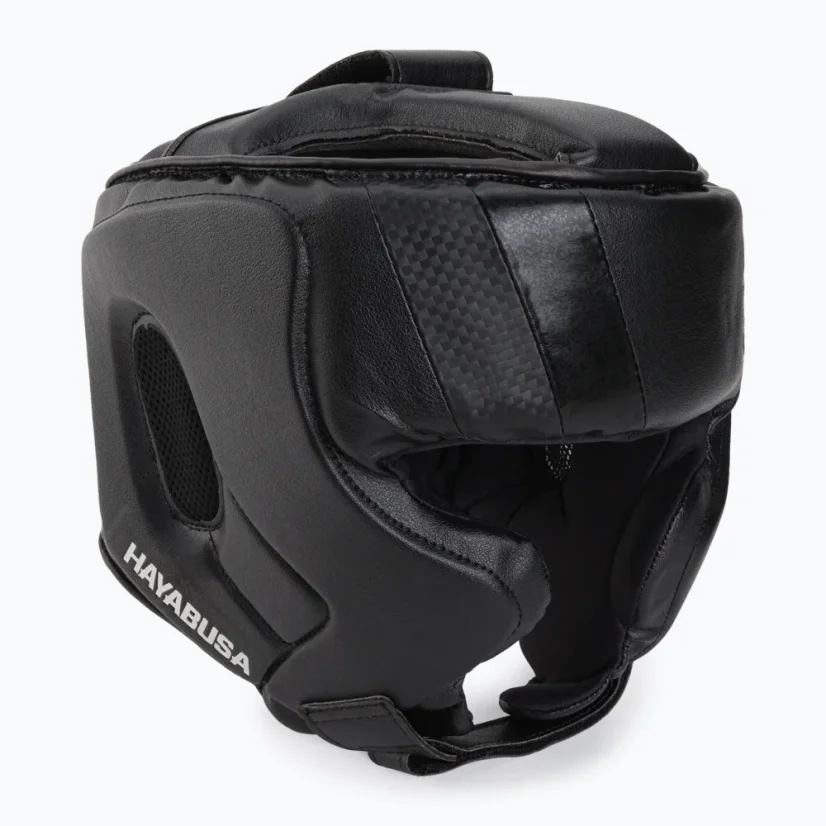
Hayabusa T3 – Boxing Headgear with Full Cheek Protection

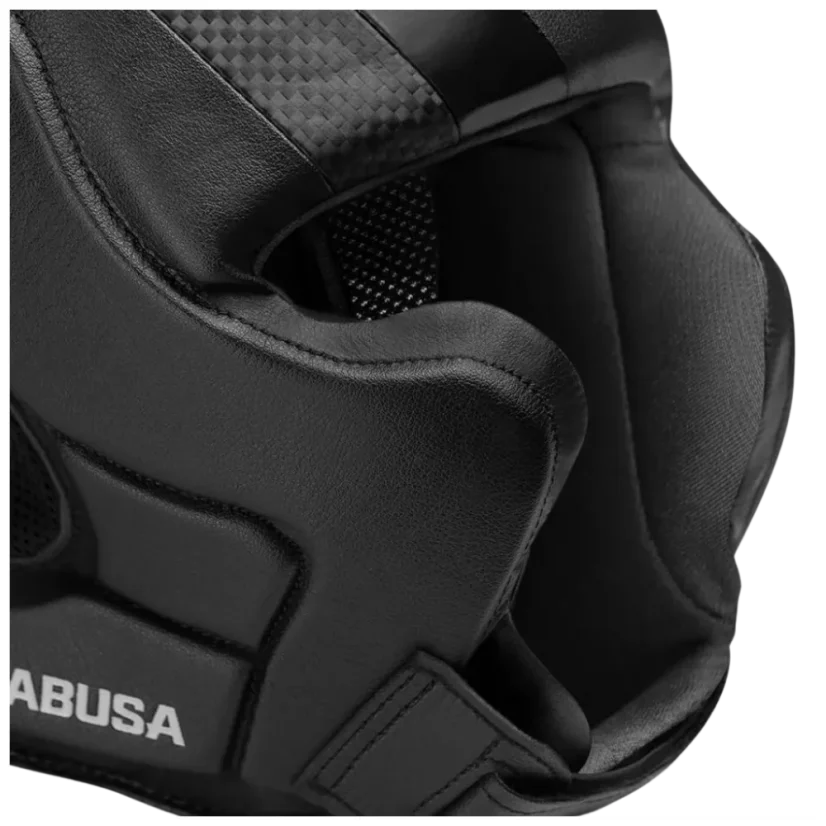
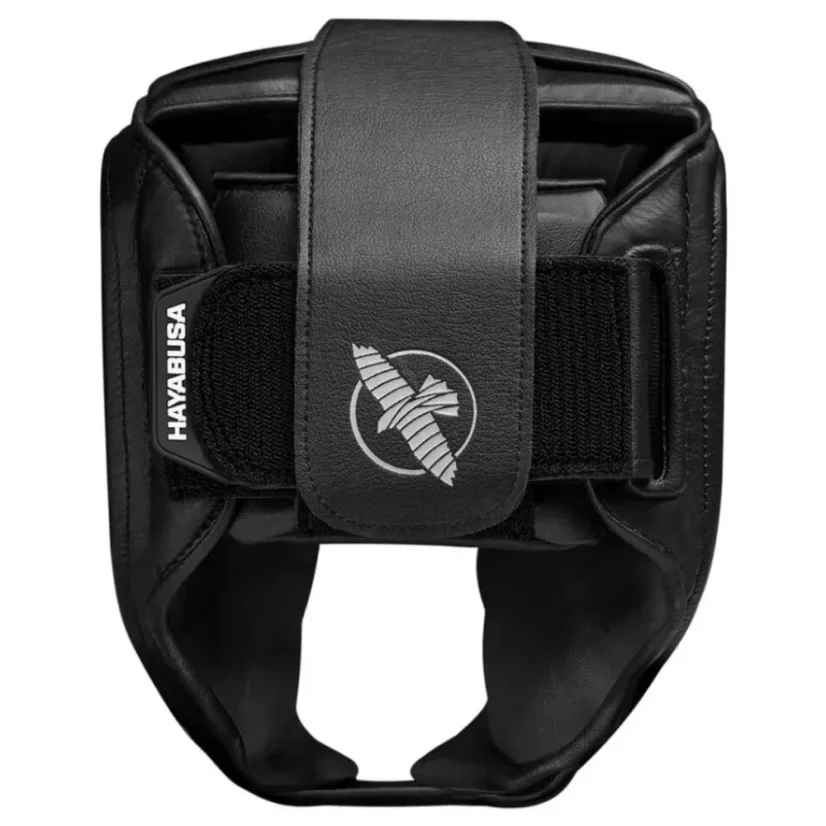
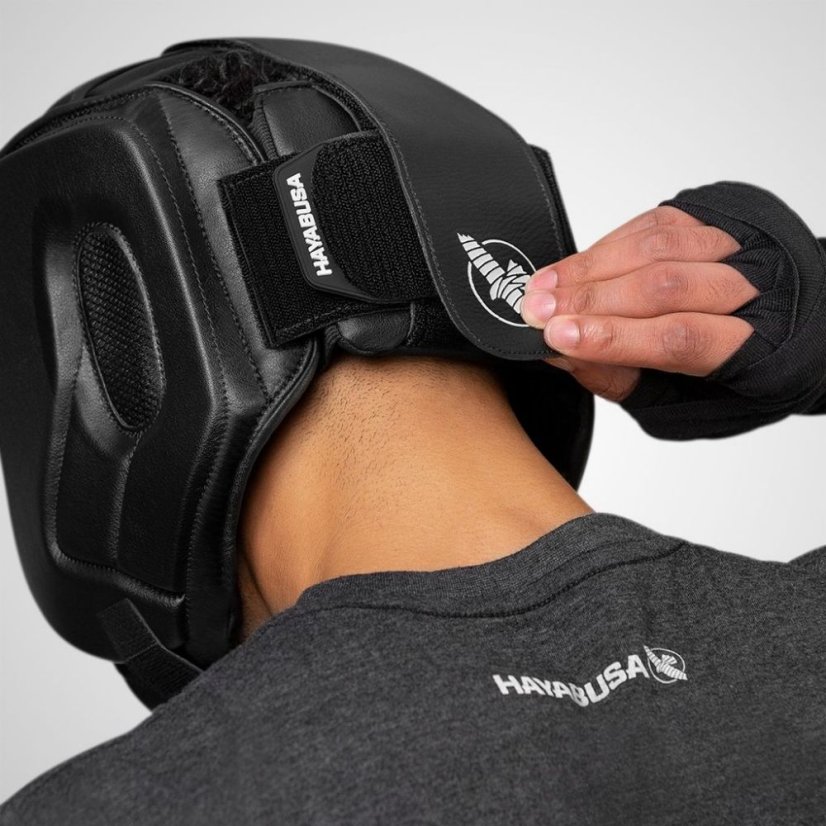
The Hayabusa T3 Boxing Headgear is cut in the Mexican style: a compact profile, full cheek protection and an open face that doesn't cost you your field of vision. It's the classic boxing "chinless" build – the chin strap holds the headgear in place, but doesn't cover the chin itself. Exactly what you need when you're reading your opponent's shots in the ring and need maximum visibility. At its core sits the patented T-Cross® closure paired with the chin strap – the headgear won't shift mid-sparring and you won't need to reset it between rounds.

The outer shell is built from Vylar®, an engineered leather that's practically indestructible and holds up to sweat and years of hard training. Inside, multi-layered foam spreads the energy of an impact instead of transferring it straight through.

The open top and mesh ear coverings vent heat out. Your head stays cooler, you'll hear your coach's calls, and the headgear dries faster after training.

The inner lining is soft to the touch and won't chafe even through longer rounds. The T3 suits beginners and advanced competitors alike – for boxing, kickboxing and Muay Thai.

Technical Specifications

Padding: Multi-layered technology foam
Material: Engineered leather Vylar®
Closure: T-Cross® + chin strap
Lining: Ultra-soft fabric
Ventilation: Open top, mesh ear coverings
Style: Chinless (no chin coverage)
Best for: Sparring – beginner through advanced

Size Chart

Size Head Circumference Best fit for
S/M 51 cm – 58 cm (20" – 23") Women, juniors, smaller-headed men
L/XL 58 cm – 66 cm (23" – 26") Most adult men

If you're between sizes, go smaller – the T-Cross® closure gives you a wide adjustment range to dial in the fit.

Frequently Asked Questions (FAQ)

What's the difference between the T3 Boxing and T3 MMA headgear?

The T3 Boxing (this product) is a "chinless" design – the chin strap keeps the headgear secure, but it doesn't cover the chin itself. It's the classic boxing cut built for maximum visibility. The T3 MMA adds full chin coverage and suits closer-range exchanges in grappling, where shots from below are more of a risk. Both variants are priced the same, so it's worth checking which discipline you train before buying – for pure boxing and distance sparring, go with the T3 Boxing.

Does the T3 protect my nose, or do I need a headgear with a nose bar?

The T3 is an open, Mexican-style headgear – it covers your forehead, temples, ears and cheekbones, but leaves your nose exposed. That's a deliberate trade-off: nose-bar headgear protects the nose but significantly narrows your field of vision, making it harder to see your opponent's shots coming. If you've had a broken or sensitive nose, go with a bar model instead. For regular technical work and even harder sparring, the open design is what most boxers choose.

Will the headgear spin around and cover my eyes while sparring?

That's exactly what the T-Cross® closure is built to prevent. Two crossed straps at the back hold the headgear in three points, and the chin strap stops it from riding up. The key is tightening it while cold, before you warm up – after a few rounds, once you've loosened up, check it and retighten if needed.

Will this headgear protect me from a concussion?

No, and no boxing headgear can guarantee that. The padding reliably cushions surface injuries – cuts, scrapes, black eyes, cauliflower ear – but a concussion comes from the brain rotating inside the skull, which headgear can't prevent. Treat it as face protection, not a green light for harder sparring. Intensity is something to agree on with your training partner and coach.

How do I measure my size correctly?

Take a soft tape measure and wrap it around your head about an inch above your eyebrows and ears – the widest point of your skull. Compare the number to the chart above. If you're right on the 58 cm / 23" border, size down – headgear needs to sit snug, and you want the straps to still have room to tighten further.

How do I clean the headgear so it doesn't start to smell?

After training, wipe it down inside and out with a cloth lightly dampened with warm water and let it air dry outside your gym bag – never on a radiator or in direct sun. Vylar® doesn't hold up to harsh cleaners or leather conditioners, which trap moisture inside the material instead of letting it out. The open top helps the headgear dry noticeably faster than closed designs.

Parameters
Product Line T3
Material Real leather
Color Black
Sport Box, MMA, Kickbox, Muay Thai
Target For men, For women

Protective gear: correct use and care

Protective gear only works when it fits properly and stays clean. A badly moulded mouthguard doesn't protect the way it should, and damp shin guards break down from the inside. The few minutes after training decide how long your gear lasts.

How to mould a SISU mouthguard
The most important difference: SISU is not moulded in boiling water. Boiling water damages the material. Use water that is hot to the touch but not boiling.
What you'll need
  • A bowl of hot, not boiling, water
  • A fork or spoon to lift it out
  • A mirror
Step by step
  • Wash your hands and rinse the mouthguard
  • Before you soak it, dry-fit it to see how the bite surface sits on your teeth
  • Place the mouthguard in the hot water and let it soften
  • Fit it onto your teeth and mould it around every tooth, molars included, not just the front ones
  • Spread the material so it covers the full surface of your teeth
  • Close your lips and sip air gently, the suction finishes the shaping
What to avoid while moulding
  • Boiling water
  • Leaving the back teeth uncovered
  • Stretching the material too far, which creates oversized openings
  • Sucking in air too hard, which leaves the fit uncomfortably tight
  • Trimming it with scissors, which strips the mouthguard of its protective properties
SISU can be remoulded up to twenty times. Just put it back in hot water, it returns to its original flat shape on its own and you can start again. That helps when teeth shift and during treatment with braces.
For the warranty to apply, the mouthguard must be moulded along the entire dental arch, not just the front teeth. With braces, use the larger size and check the moulding with your orthodontist.
Standard boil & bite mouthguards

Unlike SISU, standard mouthguards are moulded in boiling water. Always follow the instructions of the specific manufacturer, the procedures differ between brands.

  • Soak it for as long as the manufacturer specifies, the material has to soften
  • Cool it briefly in lukewarm water so you don't burn yourself
  • Fit it on your upper teeth, bite down firmly and press your tongue against the roof of your mouth
  • Press the material against your gums from the outside with your fingers
  • Take it out and cool it in cold water, which sets the shape
If the fit isn't right, most mouthguards can be remoulded. The number of attempts is limited though, the material loses a little with each round.
How to clean and store a mouthguard
After every session
  • Rinse it with cold water as soon as you take it out of your mouth
  • Clean it with a soft brush and soapy water or a mouthguard cleaner
  • Let it dry completely before you put it away
  • Store it in a vented case, not loose in your bag
What to avoid
  • Hot water when cleaning, the mouthguard would lose its shape
  • Abrasive toothpaste
  • Dishwasher, steriliser, microwave
  • Leaving it in the car or in the sun, heat will warp it
  • Chewing on it outside training
When to replace it: cracks, torn spots or bite-through damage · it no longer holds onto your teeth · warping that remoulding won't fix · odour that stays after cleaning.
Shin guards
Getting the fit right
  • The guard has to cover the shin along its full length and must not rotate to the side
  • The instep pad belongs on top of the instep, not under it
  • Fasten the straps firmly, but not so tight that they restrict circulation
Care after training
  • Take them out of your bag and let them dry at room temperature
  • Wipe the surface with a damp cloth, treat the inside with a gear spray
  • Treat leather models with leather conditioner every two months
  • Pull lint out of the velcro regularly, otherwise it stops holding
Guards with a hard shell or foam padding don't belong in the washing machine or the dryer. Fabric guards without a rigid insert are washed according to the label, at a low temperature and without fabric softener.
When to replace them: cracks in the foam or shell · the padding has flattened and you feel the impact · stretched straps · the instep pad twists out of place.
Headgear
Getting the fit right
  • Headgear must not shift when you move your head or narrow your field of vision
  • The cheek pads sit on your cheekbones, not in your line of sight
  • Tighten the chin strap so the headgear stays put on its own
Care after training
  • Wipe out the inside and let it dry outside your bag
  • Wipe the surface with a damp cloth, sweat contains salt and salt damages the material
  • Treat leather headgear with conditioner every two months
  • Don't dry it on a radiator or in the sun, it damages both the material and the print
When to replace it: the foam has hardened or cracked · the chin strap or closure no longer holds · the headgear slips during sparring.
Body protectors and groin guards
Groin guards
  • The cup has to sit firmly and must not shift while you move
  • Always take out a removable cup before washing
  • Wash the fabric part after every session, at a low temperature and without fabric softener
  • Wipe the cup with a damp cloth and let it dry
Body, chest and forearm protectors
  • Wipe them with a damp cloth after training and let them dry outside your bag
  • Never put foam or shell components in the washing machine
  • Check the straps regularly, on chest protectors they hold the whole thing in place
When to replace: a cracked cup · flattened or crumbling foam · stretched elastic and straps that no longer hold.
Protective gear for kids
  • Check the size every season, kids grow and gear that doesn't fit doesn't protect
  • Always mould a child's mouthguard with an adult present
  • With braces, check the procedure with an orthodontist
  • Set up a routine after training, kids won't remember the care part on their own
  • Put a moisture absorber in the bag, kids' gear stays in there the longest
What to avoid with all protective gear
  • Washing machine and dryer for anything with foam, gel or a hard shell
  • Drying on a radiator, in the sun or with a hairdryer
  • Leaving gear in a closed bag overnight
  • Storing it somewhere damp, in a garage or a basement
  • Harsh cleaners and alcohol on leather and PU surfaces
  • Sharing protective gear, and never sharing a mouthguard
How long protective gear lasts depends on how often and how hard you train, the type of impact and the material. Poor care shortens it considerably. Don't repair damaged gear, it no longer does its job.
Manufacturer Hayabusa Fightwear Inc.
Address 677 Innovation Dr. Unit 9, Kingston, ON K7K 7E6, Canada
Email customerservice@hayabusafight.com
Manufacturer's representative in the EU ED European Distribution GmbH
Address of representative in the EU Kettelerstraße 12, 97222 Rimpar, Germany
EU representative email info@europedistribution.com
%s ...
%s
%image %title %code %s
%s