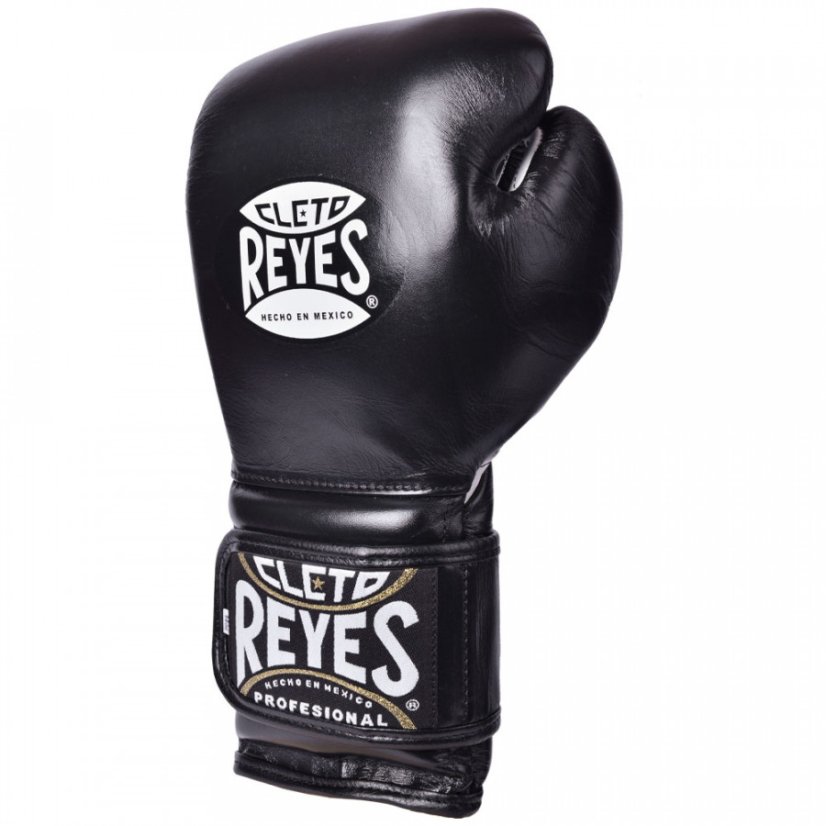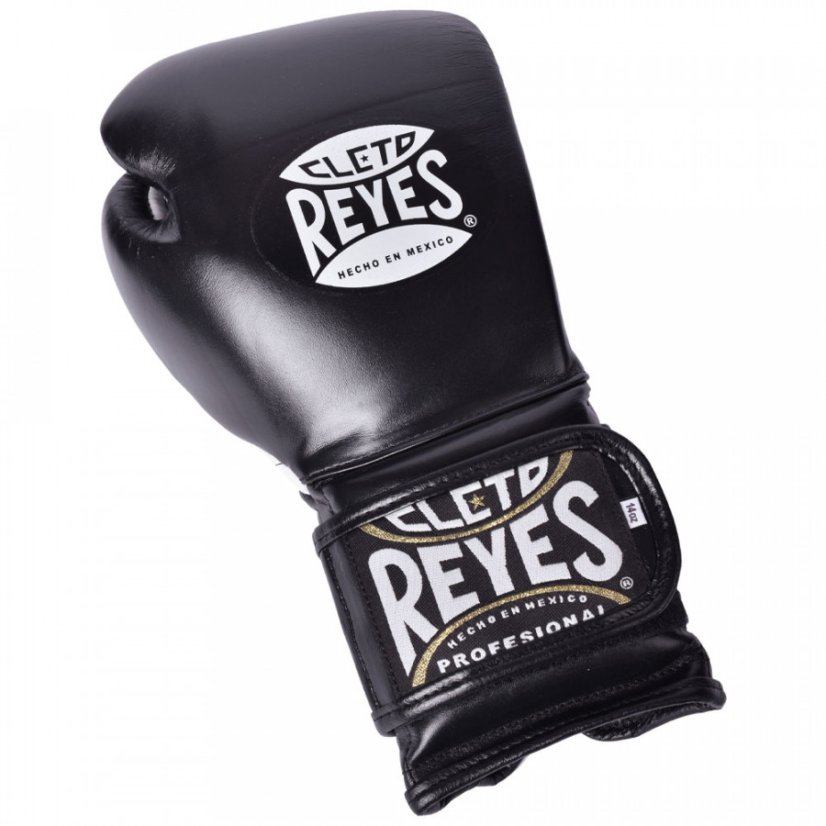

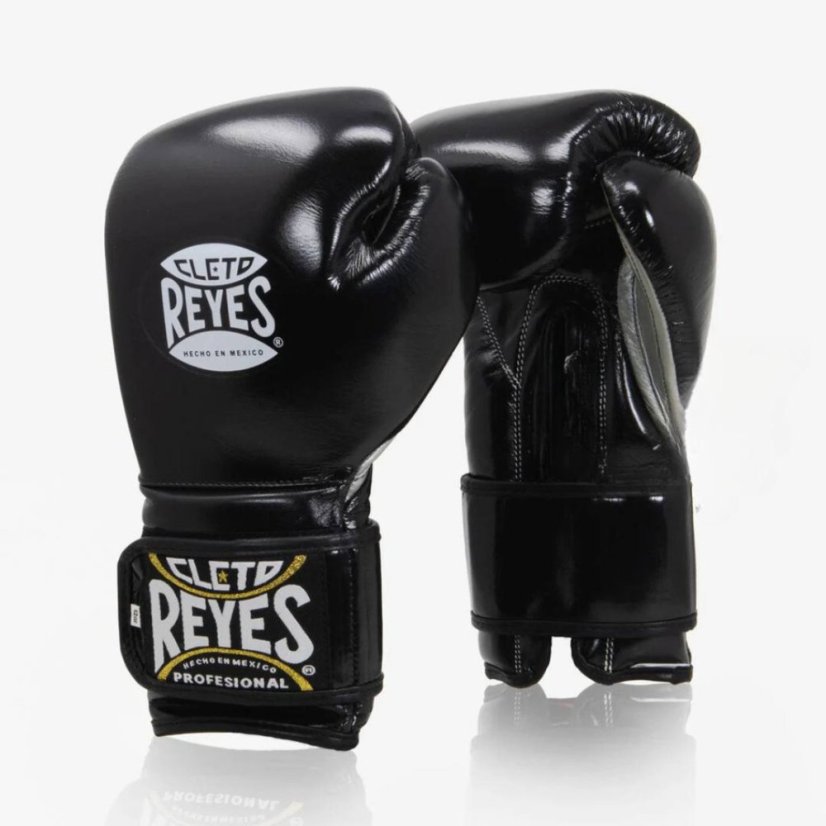
Cleto Reyes Velcro boxing gloves - black/silver - Weight of gloves: 12oz
Specify product selection
Variant does not exist
12oz 14oz 16oz
324 EUR
In stock
Cleto Reyes Key Features:
– Genuine leather
– Latex padding
– Velcro strap
– Antimicrobial lining
– Sparring use
More info
Product code: P00677-1 Shipping and Payment

Cleto Reyes Velcro – Handmade Sparring Gloves from Mexico

The Cleto Reyes Velcro gloves are a training classic from the legendary Mexican brand. They combine genuine goatskin leather, 2" (approx. 5 cm) latex foam and a hook-and-loop closure, so you can put them on and tighten them yourself – no training partner needed. Built for sparring, heavy bag and pad work.

Handmade in Mexico. Every pair is hand-stitched from premium materials – exactly what Cleto Reyes is known for among professional boxers.

Protection for you and your partner. The 2" latex foam absorbs impact, protects your knuckles and the anatomical shape keeps your fist in a natural closed position.

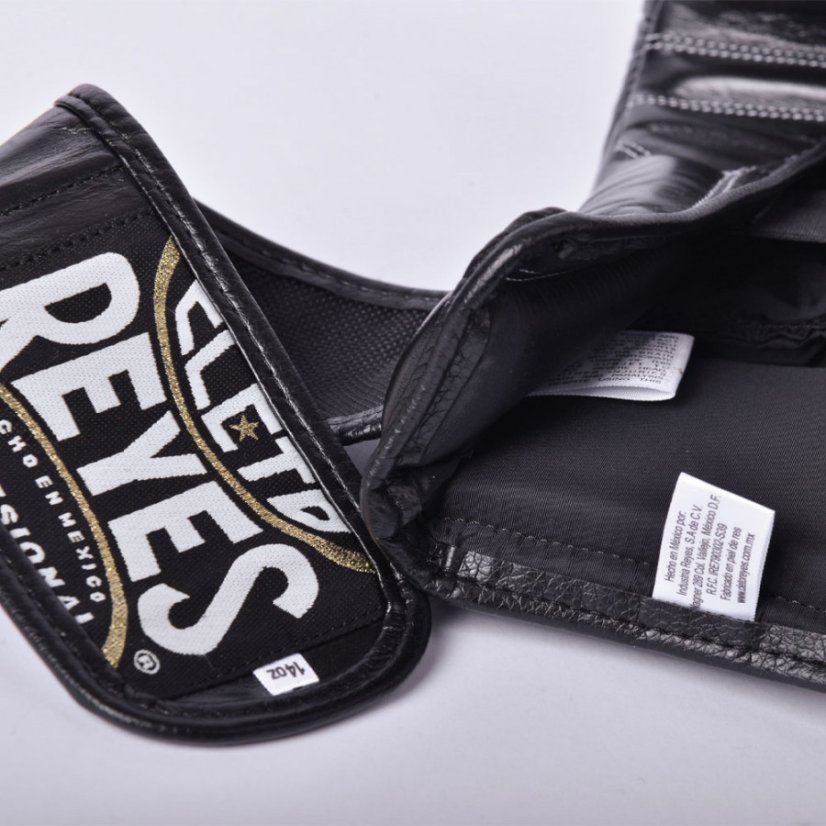
Won't soak up sweat. The water-repellent nylon lining keeps moisture out of the padding, so the gloves keep a consistent weight even after long sessions.

Attached thumb. Reduces the risk of eye injuries for your sparring partner and of sprained or broken thumbs for you.

Specifications

Material: Genuine goatskin leather
Padding: 2" (approx. 5 cm) latex foam
Closure: Leather strap with hook-and-loop
Lining: Water-repellent nylon
Thumb: Attached
Made in: Handmade in Mexico
Sizes: 12, 14, 16, 18 oz
Use: Sparring, heavy bag, pads

How to choose the right glove weight

Body weight Size Use
55 – 70 kg 12 oz Heavy bag, pads
70 – 85 kg 14 oz Training, light sparring
85 – 100 kg 16 oz Sparring
over 100 kg 18 oz Hard sparring

The right glove weight may vary depending on your training style and your coach's advice.

Frequently Asked Questions (FAQ)

Are Cleto Reyes Velcro gloves good for sparring?

Yes. The 2" latex foam and attached thumb protect both you and your partner. Most boxers spar in 14–16 oz, heavier fighters go for 18 oz.

Velcro or lace-up – which is better?

You can strap Velcro gloves on yourself in seconds – ideal for everyday training when you switch between bag, pads and sparring. Lace-ups lock the wrist in a bit tighter, but you always need someone to tie them for you.

Do Cleto Reyes gloves need breaking in?

Yes, the leather and foam are stiffer at first. After 3–6 sessions on the bag or pads, the gloves mould to your hand and the foam reaches its optimal flex.

Do the gloves soak up sweat and get heavier?

The water-repellent nylon lining keeps moisture away from the padding, so the weight stays consistent. Leave them open to dry after training.

Parameters
Material Real leather
Weight of gloves 10oz, 12oz, 14oz, 16oz
Color Black
Sport Box, Kickbox, Muay Thai
Target For men, For women
Usage Training

Caring for boxing gloves, hand wraps and gel gloves

Gloves are ruined by moisture, not by punches. Sweat stays in the padding, breaks the material down from the inside and creates an odour that is very difficult to remove. Poor care shortens the lifespan considerably, while a few minutes after training extends it. Always check the instructions for the specific product as well, the manufacturer's guidance takes precedence over general recommendations.

How to dry boxing gloves after training
Right after training
  • Take the gloves out of your bag, don't leave them in there overnight.
  • Undo the velcro and open the gloves as wide as they will go.
  • Wipe the lining out with a dry cloth or kitchen paper.
  • Stand them opening down so the moisture can drain out.
At home
  • Dry at room temperature, ideally somewhere with moving air.
  • Expect full drying to take up to a whole day, depending on the material.
  • Training daily? Rotate two pairs, a single pair won't dry in time.
Never dry gloves on a radiator, in direct sun or with a hairdryer. Heat dries out the leather, warps the foam padding and damages glued seams.
What to do about smelly boxing gloves

The smell comes from bacteria multiplying in damp padding. There are three steps and each one solves something different.

1. Removing the moisture
  • Put a bamboo charcoal moisture absorber inside the gloves.
  • Leave it in between sessions, it draws the remaining moisture out of the padding.
  • Air the pouches out in the sun once a month, which regenerates them.
2. Dealing with the bacteria
  • Spray the lining with a sports equipment spray, ideally after every session.
  • Let it dry and don't close the gloves up straight after spraying.
3. Prevention
  • Always train in hand wraps or gel gloves, they absorb the sweat instead of the padding.
  • Wash wraps and gel gloves after every use, otherwise the smell goes straight back in.
Once the smell has soaked into the padding, it is practically impossible to get out. Prevention is the only thing that reliably works.
How to wash hand wraps

Wraps are your gloves' first line of defence. They catch the sweat before it reaches the padding, but only if they are clean and dry.

Washing
  • Wash them after every session, not after the third one.
  • Fasten the velcro and put them in a mesh laundry bag, otherwise they tangle.
  • Wash cycle up to 40 °C, delicate or sports programme.
  • No fabric softener, it clogs the fibres and the wraps stop absorbing sweat.
  • Don't use bleach, it breaks down the elastic fibres.
Drying and storage
  • Dry them unrolled, hung up or laid out flat.
  • Not in the tumble dryer, heat destroys the elasticity.
  • Only roll them up once they are completely dry, a damp rolled wrap will go mouldy.
  • Store them rolled rather than crumpled, they go on faster next time.
Keep at least three pairs in rotation. One on your hands, one in the wash, one dry in your bag.
When to replace them: the wrap has lost its stretch and no longer tensions as you wind it · frayed edges · the velcro doesn't hold · odour that stays after washing.
Gel gloves and inner gloves

Gel gloves take less abuse than textile wraps. The gel insert is sensitive to heat and to the strain of a washing machine.

Cleaning
  • Hand washing in lukewarm water with a little delicate detergent is the gentlest option.
  • In the machine, only in a mesh bag, on a cold or delicate cycle up to 30 °C.
  • Never bleach or fabric softener.
  • Don't wring or twist them, the gel separates from the backing.
Drying
  • Dry flat at room temperature.
  • Never in the dryer, on a radiator or in the sun.
  • Heat makes the gel soften, deform and lose its cushioning.
Gel gloves don't replace wraps for hard training and sparring. They don't stabilise the wrist the way a properly wound wrap does.
When to replace them: the gel has hardened, cracked or is peeling away · the insert slides off the knuckles · the fabric has stretched and the glove no longer stays put.
Outer material care
Genuine leather
  • Wipe with a damp cloth after training, this removes sweat and salt.
  • Treat with leather conditioner every two months.
  • Without care, leather dries out, hardens and cracks at the seams.
Synthetic leather and PU
  • A damp cloth is enough, no conditioner needed.
  • Don't use harsh cleaners or alcohol, they attack the surface layer.
Velcro
  • Clear lint and hair out of it regularly, otherwise it stops holding.
  • Keep it fastened in storage so it doesn't clog up.
Choosing the right glove type for your training

Most gloves aren't ruined by poor care but by the wrong use. Each type has different padding and a different purpose.

  • Sparring gloves – softer, bulkier padding that protects your partner. They wear out fast on the bag.
  • Bag gloves – firmer, more compact padding that stands up to thousands of strikes on hard surfaces.
  • Training gloves – the compromise for everyday training, technique, pads and light sparring.
  • MMA gloves – open fingers, minimal padding. Not a substitute for boxing gloves.
  • Competition gloves – for fights only, the least padding and the shortest lifespan.
Sparring gloves used on the heavy bag are the most common reason padding flattens prematurely.
Kids' boxing gloves
  • The care routine is the same, children just don't remember it on their own, so set up a routine after training.
  • Check the size every season, gloves that are too small pinch and restrict wrist movement.
  • Don't buy significantly larger ones in advance, the glove has to fit around the fist.
  • Put a moisture absorber in the bag, children's gear stays in there the longest.
What to avoid
  • Washing machine and dryer for gloves – this ruins the padding and the shape beyond repair
  • Radiators, direct sun, hairdryers, car heating
  • A closed sports bag overnight
  • Storage in a cellar, garage or any other damp space
  • Training without wraps or gel gloves
  • Sharing gloves between several people
When to replace boxing gloves
  • You feel your knuckles on impact, the padding no longer cushions
  • The padding has flattened and feels hard or uneven
  • Cracks in the material, seams coming apart
  • The velcro no longer holds the wrist firmly
  • The odour stays even after cleaning and drying
How long gloves last depends on how often and how hard you train, the type of impact and the material. Poor care shortens it considerably.
Manufacturer Industria Reyes S.A. de C.V.
Address Calle Wagner 289, Col. Vallejo, CP 07870, Ciudad de México
Email export@cletoreyes.com
Manufacturer's representative in the EU Sports E-Sports 2017 S.L.
Address of representative in the EU Calle de la Resina 13-15, Nave 4-5, 28021 Madrid, Spain
EU representative email info@cletoreyes.net

More products to choose from3

%s ...
%s
%image %title %code %s
%s