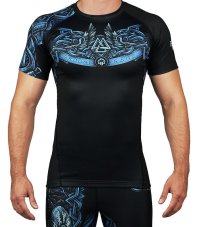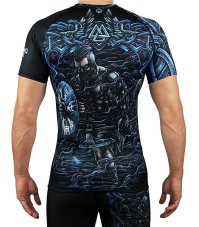

Rashguard or Compression Shirt? How to Choose the Right Gear for BJJ and MMA
Not sure whether you need a rashguard or a compression shirt for BJJ or MMA? At first glance they look the same – tight, functional, athletic. But they serve different purposes. The wrong choice means discomfort on the mat, fast wear, or wasted money. Here's what each piece of gear actually does and how to choose correctly.
In this article:
1. What is a rashguard and why do fighters wear one?
A rashguard is a tight-fitting functional shirt with long or short sleeves, originally developed for surfers – hence the name (rash = skin abrasion, guard = protection). It made its way into combat sports with the rise of BJJ and No-Gi Grappling, where training happens without a gi and direct skin contact with the mat is unavoidable.
The three core functions of a rashguard: skin protection against mat burns and bacteria, moisture wicking, and muscle compression. The seams are flat or reversed – nothing digs in, chafes, or catches on your training partner's fingers.
In BJJ, rashguard color also signals belt rank – the same way the belt does on a gi. White, blue, purple, brown, black. At IBJJF competitions the color coding is mandatory. If you compete, check your federation's rules before buying.
Browse the full range in our Rashguards at Senteso.com category – short and long sleeve, men's and women's, brands including PRiDEorDiE, Revgear, and Hayabusa.
2. How it differs from a compression shirt
On the surface they look nearly identical. Both are tight, both synthetic, both wick sweat. But the differences are significant – and you'll feel them on the mat or at your first sparring session at the latest.
| Rashguard | Compression Shirt | |
|---|---|---|
| Primary purpose | Skin protection in contact with mat/partner | Muscle compression, thermoregulation |
| Seams | Flat or reversed – no raised edges | Standard – can dig in or chafe |
| Fabric weight | Reinforced – abrasion and tear resistant | Standard – not built for contact sport |
| Stretch | 4-way stretch – moves in every direction | Usually 2-way – for linear movement |
| Suitable for grappling | ✓ Yes – primary use case | ✗ No – wears out fast, causes chafing |
| For boxing / gym | ✓ Yes – as a base layer | ✓ Yes – ideal |
| Price | From approx. $35 | From approx. $20 |
Bottom line: A compression shirt works great under a gi, for boxing, or at the gym. A rashguard is what you need any time you're training without a shirt in direct contact with the mat or your partner.
3. When you need a rashguard – specific situations
BJJ No-Gi – a rashguard is essential gear. You train without a gi, skin contact with the mat is constant. Without one you're risking mat burns and skin infections every session.
MMA sparring – worn as a base layer under shorts. It protects your torso during ground work and doesn't cause friction in the clinch. Many clubs require it.
Wrestling / Sambo – same reasons as No-Gi BJJ. Intense mat contact, explosive movement – a rashguard is standard.
BJJ Gi – worn under the gi top instead of a t-shirt. It wicks sweat better than cotton and stays in place under the jacket.
Boxing / Muay Thai – not essential, but some fighters wear one under pad work as a base layer. A compression shirt is an equally valid option here.
4. What to look for when buying
Fabric and weight – standard rashguards are made from polyester and spandex at roughly 85/15 or 77/23. More spandex = more stretch. 200–230 g/m² is the training standard. Lighter fabrics (180 g/m²) for summer, heavier (250+ g/m²) for competition and heavy use.
Cut – short or long sleeve – long sleeves protect the forearms (the most common friction point in grappling), short sleeves are cooler. For beginners we recommend long sleeves – more protection while you're learning mat technique.
Seams – flatlock stitching is the absolute standard on quality rashguards. Reversed seams are even more comfortable. Anything with a raised seam at the shoulder or side is not a combat sports rashguard.
Length – the rashguard needs to stay tucked in through submissions and sweeps. A short model rides up and leaves your lower back exposed. Check the length measurement in the size chart – grappling-specific models often feature an extended hem as standard.
Sublimation vs. screen printing – sublimation printing goes directly into the fiber, won't peel, and won't fade. Screen printing can crack over time. You can identify sublimation by feel – the surface is completely smooth with no raised ink layer.
5. Technical specs – comparison table
Technical specs
| Spec | Rashguard (BJJ / MMA) | Compression Shirt |
|---|---|---|
| Fabric | 85% polyester / 15% spandex (typical) | 88% polyester / 12% elastane (typical) |
| Weight | 200–250 g/m² | 160–200 g/m² |
| Stretch | 4-way stretch | 2-way to 4-way stretch |
| Seams | Flat (Flatlock) or reversed | Standard or flat |
| Sublimation (durable) | Sublimation or screen print | |
| Sleeve length | Short / long | Short / sleeveless |
| Sports | BJJ, MMA, Wrestling, No-Gi Grappling | Boxing, gym, running, under gi |
| Price (approx.) | $35–$85 | $20–$50 |
Browse all rashguards in the Rashguards at Senteso.com category. Compression shirts and other training apparel are available under Clothing.
FAQ – Frequently asked questions
Can I use a regular compression shirt instead of a rashguard for BJJ?
Technically yes, but we don't recommend it. A compression shirt has no reinforced fabric or flat seams designed for contact sport. After a few weeks of intense No-Gi training it'll be torn or worn through – and your skin will notice before that. A rashguard is built specifically for this kind of stress and lasts significantly longer.
What rashguard should a complete beginner get?
For starters, go with a long-sleeve model in a basic color (white or black) from Revgear or PRiDEorDiE. You don't need an expensive one – correct sizing and flat seams matter more. Size it snug, not loose. Check our rashguard selection and use the size chart.
Does a rashguard need to be a specific color for BJJ competition?
It depends on the federation. The IBJJF requires the rashguard color to match the competitor's belt rank (white, blue, purple, brown, black). Other federations or local tournaments may have different rules or no color requirement at all. Always check the specific event's ruleset before buying.
How do you wash a rashguard properly?
Wash at 30°C (86°F), no fabric softener (it degrades elastic fibers) and no tumble dryer (heat damages the print and spandex). Turn it inside out before washing to protect the sublimation print. After every session rinse it in cold water as soon as possible – sweat and bacteria break down the fabric faster than the wash itself.
Do you wear a rashguard directly on skin or over a shirt?
Always directly on skin. That's the only way it does its job – wicking sweat, protecting skin, staying body-close. A shirt underneath kills the compression, increases heat, and makes the rashguard pointless. Under a gi, the rashguard replaces a shirt – it doesn't go over one.

Our top picks from the collection6


PRiDEorDiE Brotherhood V2 LS Rashguard


Rashguard No-Gi REVGEAR Ranked LS – Brown


Revgear Grizzly Jiu-Jitsu Rashguard LS – Red


PRiDEorDiE Brotherhood V2 SS Rashguard


Revgear Grizzly Jiu-Jitsu Rashguard LS - black